
Social impact: Inspired deaf designers make their paths to architecture
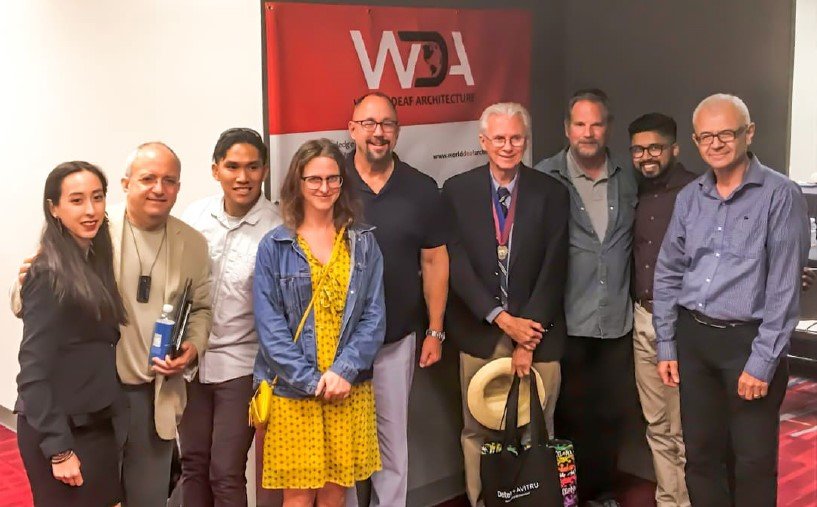
WORLD DEAF ARCHITECTURE SYMPOSIUM AT A'19 CONFERENCE ON ARCHITECTURE
By Steve Cimino, October 9, 2020
Robert Nichols, Assoc. AIA, lost his hearing as a boy. But his parents didn’t want to send him to a school for the deaf, instead preferring to “mainstream” him in schools with children who could hear. As a teenager, Robert was interested in learning how to make models, furniture, and houses. With this determination and his parents' support, he found an opportunity with an architect in his community through his local employment center in New Jersey.
This continued throughout college, as he attended Cornell University in the late 1970s and dealt with professors who, in his words, “didn’t want to deal” with his hearing loss. At one point, he even sued the university to get the interpreting services he needed to learn properly.
“One good thing about all that,” he said, “is I grew up and became courageous.”
Nichols is the now the executive director of World Deaf Architecture (WDA) – a non-profit organization that supports professional architects, designers, and teachers who are deaf, deaf-blind, hard of hearing or have severe hearing loss – and the owner of Nichols Design Associates in Washington, DC. Due in part to his deafness and his experiences as a young man, he follows the principles of universal design in his projects, striving to provide proper access to all who use his spaces.
“It doesn’t matter if the person I’m designing for has disabilities or if they don’t,” he said. “I still apply the universal design principles.”
Jade Ragoschke, Assoc. AIA, had her own difficulties finding a place in the profession. Hard of hearing since birth, she’d always felt stuck between two worlds. “You’re either too hearing to be considered deaf or too deaf to be considered hearing,” she said.
She fell in love with architecture in a very roundabout way; her friends in the Chicago parkour community invited her to a design film festival, where a documentary about a Bjarke Ingels-designed parkour park changed her life. Now an associate architect and accessibility consultant at EME Group, she credits WDA – where she serves as vice president – for opening her eyes to a whole new realm within the design community.
“Because I grew up in mainstream schools, I didn’t know any deaf or hard of hearing architects,” she said. “Once I joined WDA, I instantly met designers like myself and saw their struggles and successes. That inspired me to own my own deafness and to focus on bringing the necessary resources to this community.”
John Stanton Jr, AIA, is the owner of Stanton Architects, the president of WDA, and a hard of hearing architect. As a kid, all he wanted to do was take apart everything around him and then put it all back together.
“It was just my nature,” he said. “I had to know how something worked, why it worked, how it was made.”
After attending the National Technical Institute for the Deaf in Rochester, New York, he studied architecture at Notre
Dame University. Though his fellow classmates were very competitive in the studio, Stanton wasn’t built that way. He didn’t want to ‘win’; he just wanted to design.
“I was there to learn,” he said, “and to understand how to create spaces.”
Stanton was never nervous about asking a follow-up question or petitioning professors to repeat themselves. Though profoundly deaf since birth, he has always focused on the pros that lacking one of his senses seemed to provide.
“I didn’t think of it as a negative,” he said. “I saw it as a positive. I think I had more of an advantage over others who have perfect hearing because I innately had to balance it out and improve my other senses. My wife still doesn’t believe how well I can taste and smell.”
Regardless of where they came from, all three of these designers want to open up new career opportunities for anyone who is deaf or hard of hearing and dreams of practicing architecture.
“When I was younger, I worked in a large office for a big firm and learned quickly that it wasn’t for me,” Nichols said. “They asked me to focus on one narrow design phase when I knew I could do more. We want to help architects and designers who may also feel that way today, or those who run into other hurdles, to know that options are out there.”
“I want to be a role model for deaf aspiring architects, to let them know that we all had difficulties as well when we were younger,” Stanton said. “It’s just a matter of learning to communicate. So many people just don’t know who we are or what we need; they’re not in our shoes. Deaf and hard of hearing designers and architects need to find the best way to communicate, a way that works for them and for others around them.”
“Our goal in WDA is to create more exposure and networking opportunities,” Ragoschke said, “and to inform everyone within the profession of our needs. We want to create a space where people can reach out to us and a community where we can all share our experiences.”
The AIA continues to advocate for inclusivity for members and the profession. Within the AIA, 129 active members have self-reported through their individual membership profiles that they are deaf or hard of hearing. It is essential to our values that we continue to support equity, diversity, inclusion, and belonging in the profession.
The AIA is committed to celebrating the many cultures and heritages that represent the architecture profession. Embracing Our Differences, Changing the World is a series aimed to celebrate members that break the mold, shatter glass ceilings, and overcome preconceived implicit biases.